 fr
fr
 English
 русский
 Español
 Français
Accueil / Actualités / Actualités de l'industrie / Low Temperature Thermocouple Guide: Types, Accuracy, and Selection Tips

Actualités de l'industrie
2026-08-12
Low Temperature Thermocouple Guide: Types, Accuracy, and Selection Tips
A quality engineer at a frozen-food plant called us with a familiar problem: her Type K thermocouples in a -40°C spiral freezer read two to four degrees warm, and the error grew after every defrost cycle. Controllers, cables, and connectors all tested fine. The sensors themselves were the problem — or rather, the thermocouple type was.
Below about -40°C, standard nickel-alloy thermocouples stop behaving the way they do at process temperatures. Type T (copper–constantan) and Type E (chromel–constantan) are the practical choices for cold service , and below -100°C a platinum RTD usually out-accuracies both.
This guide covers which thermocouple types genuinely work at low temperatures, the accuracy you can expect from each, and the installation mistakes that ruin more cold-service readings than failed elements do.
What Counts as Low Temperature for a Thermocouple?
In thermocouple engineering, low temperature usually means anything below -40°C, the point where Type K and Type N elements begin to lose the thermoelectric uniformity they show at process temperatures. Cryogenic measurement extends this down to about -200°C, the practical floor for copper-based thermocouple alloys. Below that, only specialized elements such as chromel–gold/iron respond reliably.
The international standards governing thermocouples, IEC 60584 and ASTM E230, publish ranges for every letter-designated type, and all of them reach -200°C or lower. The difference is accuracy: tolerances at those cold extremes are far from equal.
| Type | Positive leg | Negative leg | Standard range | Low-temperature suitability |
|---|---|---|---|---|
| T | Copper | Constantan | -200 to 350°C | Best accuracy below 0°C |
| E | Chromel | Constantan | -200 to 900°C | Excellent; highest output of standard types |
| K | Chromel | Alumel | -200 to 1250°C | Adequate; accuracy erodes below -40°C |
| J | Iron | Constantan | -210 to 760°C | Usable; oxidation and homogeneity risks |
| N | Nicrosil | Nisil | -200 to 1300°C | Moderate; no low-temperature advantage |
Which Thermocouple Type Works Best in Cold Service?
Type T — the low-temperature specialist
Type T is the only standard thermocouple built with a copper leg, and that copper leg is why it dominates low-temperature work. High-purity copper is exceptionally homogeneous, so it generates few of the small voltage offsets found in complex nickel alloys. Type T holds excellent accuracy from -200°C to 0°C and is the default for environmental chambers, cold rooms, and cryogenic test setups. The trade-off is the top end: copper oxidizes quickly above 300°C, so Type T should never see a hot sterilization cycle.
Type E — high output for weak signals
Type E delivers about 60 µV per degree at 0°C, the highest signal of any standard thermocouple. The larger voltage reduces the influence of electrical noise, which matters when signal levels are small. Its low-temperature repeatability approaches Type T, and its range extends to 900°C. Choose Type E when the same probe must handle both cold storage and a hot cleaning or curing step.
Type K — the workhorse with limits
Type K is the most common industrial thermocouple, and it will physically operate down to -196°C. The limitation is not range but stability. Nickel–chromium alloys undergo magnetic ordering and short-range lattice changes at sub-zero temperatures, slowly shifting the thermoelectric output over time. A Type K sensor in continuous -80°C service can drift by several degrees within months — precisely the failure the frozen-food plant saw.
If your cold process runs between -20°C and -40°C and the control tolerance is ±3°C or looser, Type K with a good transmitter is acceptable. For tight control, product validation, or anything below -60°C, choose Type T or an RTD.
Type J and Type N
Type J's published range reaches -210°C, but its iron leg rusts in humid cold environments, and the standard EMF tables are least reliable at the low end. Type N offers no measurable advantage over Type K below 0°C. Neither is a sensible first choice for cold service.
Accuracy and Tolerance Classes at Low Temperatures
Thermocouple accuracy is defined by tolerance classes in IEC 60584. The tolerance is the larger of a fixed value or a percentage of the measured temperature, and both formulas work in favor of cold service. At -100°C, a new, unused thermocouple should stay within the following limits:
| Thermocouple | Class | Maximum deviation at -100°C |
|---|---|---|
| Type T | Class 1 | ±0.5°C |
| Type T | Class 2 | ±1.0°C |
| Type E | Class 1 | ±1.5°C |
| Type K | Class 1 | ±1.5°C |
| Type K | Class 2 | ±2.5°C |
Treat these numbers with two considerations. First, they apply only to new sensors; aging, thermal cycling, and contamination widen the gap in service. Second, the spread is decisive: a Class 1 Type T at ±0.5°C is three times tighter than a Class 1 Type K . If the process tolerates a wider error band, Type K is fine; if it does not, the thermocouple type is the first specification you must change.
Practical Concerns That Ruin Cold-Service Installations
Most low-temperature thermocouple problems are not element failures; they are installation failures. Four issues account for nearly all of them:
- Condensation. Sub-zero service pulls moisture into connectors and terminal heads, and the resulting parallel resistance can shift a reading by several degrees. Use sealed connectors, waterproof heads, and welded-junction probes.
- Thermal shunting. The probe stem conducts heat away from the junction. In still cold gas, a large metal sheath reads low; a fine-wire or needle probe equilibrates faster and introduces less shunt error.
- Wrong extension wire. Copper cable creates unmeasured junctions. Use extension wire matched to the thermocouple type and rated for the ambient temperatures along the cable route.
- Cold-junction compensation. At -80°C, one degree of reference-junction error adds a full degree to the reading. Use transmitters with automatic compensation rather than a fixed manual value.
Thermocouple or RTD for Low-Temperature Service?
Thermocouples win when response speed, element size, or range matters more than absolute accuracy. A needle junction settles in seconds, and the sensitive zone can be under a millimeter. RTDs are slower, larger, and more sensitive to shock.
RTDs win when accuracy and stability matter more than speed. A Class A PT100 holds ±0.35°C at -100°C, and a PT1000's higher resistance reduces lead-wire error over long runs. That is why pharmaceutical freezers, cold-chain validation, and laboratory references use platinum elements.
In food processing both technologies share the same line. Operators push a needle-style sensor into a product to verify core temperature during chilling, cooking, or thawing; our needle-shaped thermocouple for food processing is built for that job. For permanent points where hygiene is critical, a food-grade stainless-steel PT1000/PT100 probe gives the long-term stability a chilled product needs.
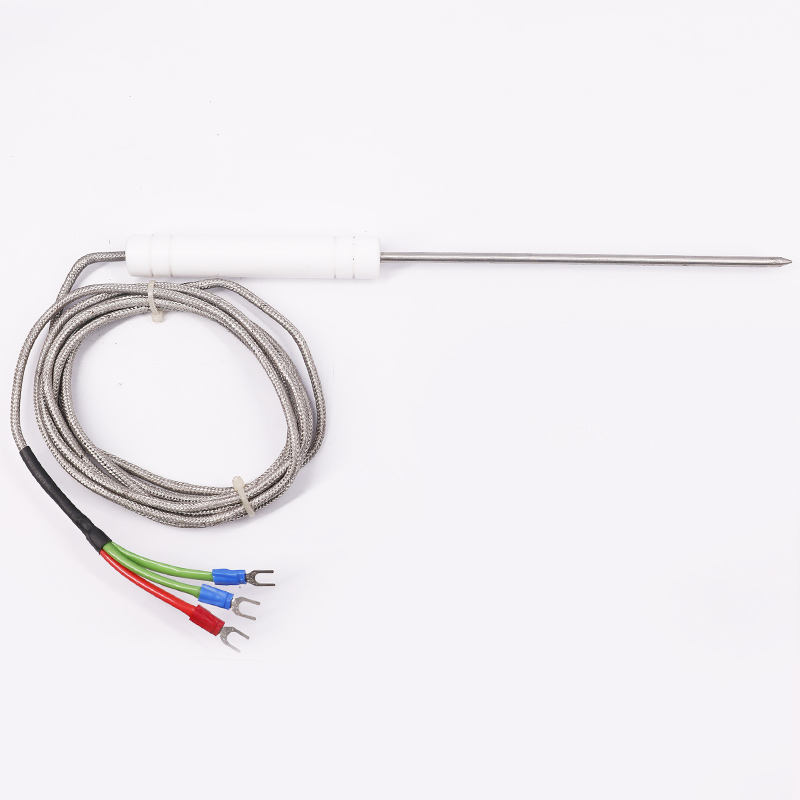 PT100/PT1000 Food-Grade Probe Temperature Sensor Suppliers, Factory Jiangsu Zhaolong Electrics Co., Ltd. is China PT100 PT1000 temperature sensor suppliers and factory, we wholesale PT1000 PT100 NTC food-g... View Product →
 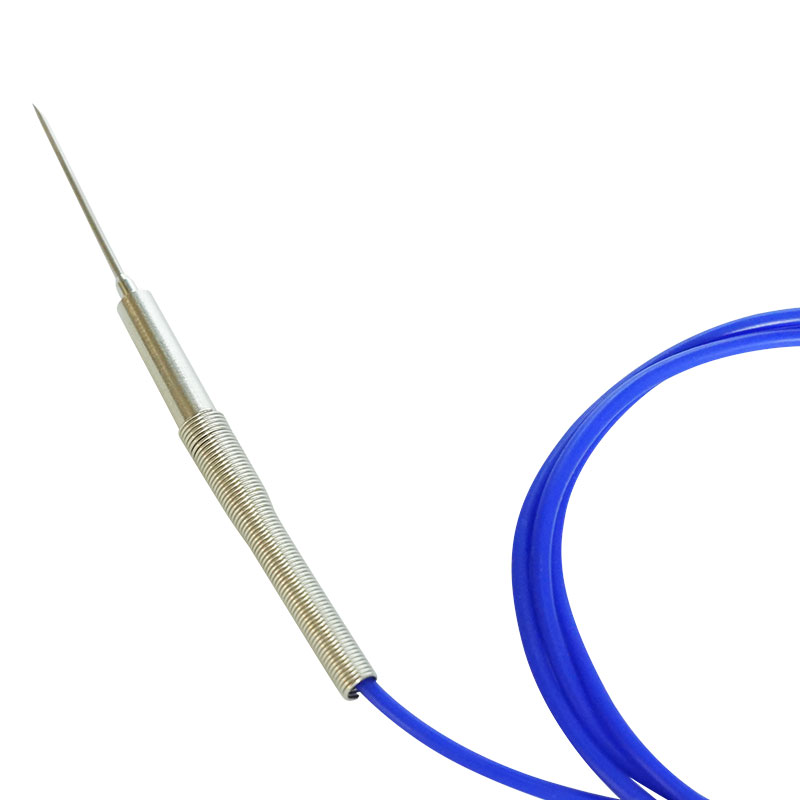 Wholesale Needle-shaped thermocouple (Applicable to the temperature measurement Jiangsu Zhaolong Electrics Co., Ltd. is China wholesale Needle-shaped thermocouple (Applicable to the temperature measurement for food pr... View Product →
 For thermal mapping of cold surfaces — condenser plates, freezer liners, insulated pipes — a high-precision self-adhesive K-type surface thermocouple installs without drilling. Surface elements are better for comparative mapping than for absolute accuracy below -40°C.
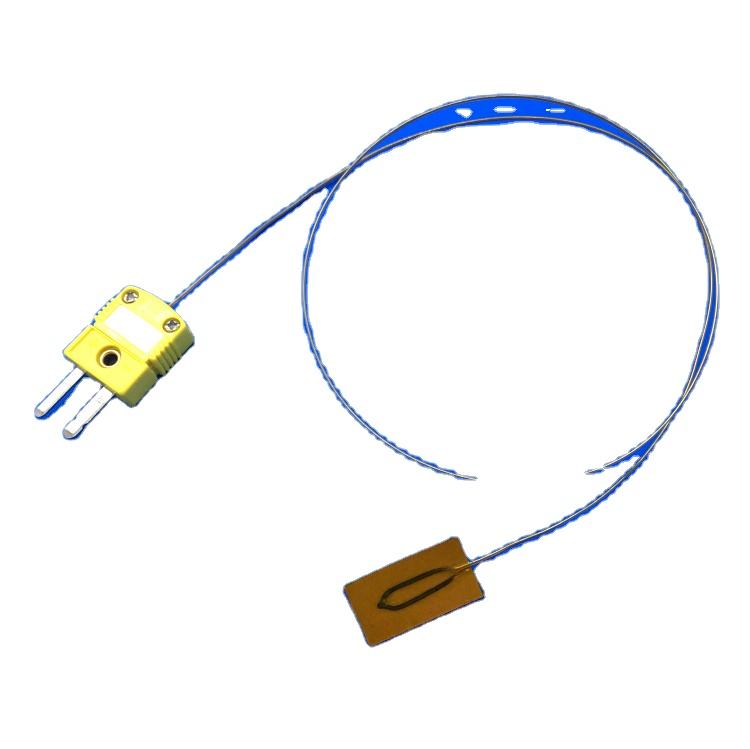 Wholesale High-Precision Surface-Mount Self-Adhesive K-Type Thermocouple for Tem Jiangsu Zhaolong Electrics Co., Ltd. is China wholesale High-Precision Surface-Mount Self-Adhesive K-Type Thermocouple for Temperature Me... View Product →
 - Choose a thermocouple when response speed, small footprint, or range matters more than absolute accuracy.
- Choose an RTD when you need stable, repeatable readings with errors at or below ±0.5°C.
- Choose a needle or surface thermocouple for spot checks and thermal surveys; choose an RTD for fixed monitoring points.
Common Low-Temperature Applications
Food processing and cold chains
Blast chillers, spiral freezers, cold stores, and inspection lines need temperature checks at many points. Sensors must be food-safe, fast, and easy to clean, which is why much of our work goes into temperature sensing in food machinery . Needle probes and small-diameter elements dominate because they measure the product core, not the surrounding air.
Pharmaceutical and biological storage
Vaccine cold chains, plasma freezers, and biobanks hold product at -70°C or below, where a few degrees of drift can ruin a batch. Validation demands traceable sensors with documented accuracy. These environments typically use Type T thermocouples for short-term mapping and PT100/PT1000 sensors for permanent monitoring.
Scientific research and analytical instruments
Environmental chambers, fatigue testing, and sensors for analytical instruments require low-thermal-mass probes that do not disturb the sample. Fine-wire thermocouples and self-adhesive elements are standard for thermal profiling, while a reference RTD supplies the calibration point.
Specifying the Right Low-Temperature Probe
Four numbers define a low-temperature sensor specification: the lowest temperature the probe will see, the maximum allowed error at that temperature, the required response time, and the environment — dry, wet, pressurized, or vibrating. Define those four before comparing products.
A probe built for a 1200°C furnace has no place in a -80°C freezer, and a bare thermocouple that performs well in still air will not survive a brine bath. The right sensor matches its junction, insulation, sheath, and connection to the actual cold-side conditions.
Because we manufacture thermocouples, RTDs, transmitters, and controllers in the same facility, we can match the element to the instrument and build custom lengths, junction styles, and fittings without the usual coordination delays. If your process runs below -40°C and accuracy matters, contact us with your low-temperature specification , and we will confirm the sensor type and configuration before you commit to a design.

À PROPOS DE NOUS
PRODUIT
COORDONNÉES.
-
 +86-181 1593 0076 (Amy)
-
 +86 (0)523-8376 1478
-
 [email protected]
-
 N° 80, Rue Chang’an, Ville de Dainan, Ville de Xinghua, Province du Jiangsu, Chine
CODE QR

Droit d'auteur © 2025. Jiangsu Zhaolong Electrics Co., Ltd.

